Driven to the bottle(s)

After a series of stressful and frustrating experimentations, it appears we have finally found a bottle that works for Lina. To be clear, she still leaks milk out of her  mouth as she drinks – a LOT of milk. It’s something we’ll be talking about with the early intervention teacher at our first therapy appointment this week. (It is thoroughly depressing to see her burp cloths soaked in my hard-won breast milk. Not to mention the laundry!) But we at least have her off the disposable nipples they sent home from the NICU, and she is able to latch appropriately onto the bottle and get enough to sustain steady weight gain. She is now just over 9 lb.

So, in case it’s helpful to anyone facing similar issues, here are the bottles we tried:

  • Disposable Similac regular flow nipples from the NICU (which we washed and reused for a good 5 or 6 weeks), paired with the Medela pump milk collection bottles – These latex-type nipples worked great for the first several weeks, but as she got bigger and stronger, the flow was much too slow. Feedings were taking an hour, and she was getting frustrated and tired trying to get the milk out of the one tiny hole. These nipples are not made in any other flow level. We tried poking larger holes in them with a heated needle but could not seem to get the size right and worried a bit about continuing to use what were supposed to be disposable nipples.
  • Dr. Brown’s glass bottles with newborn flow nipples – The shape is the same as the Similac nipples, but these are silicone rather than latex. She has refused these and any other silicone nipples. The texture seems to really throw her off.
  • Avent bottles (which Corin used) – Silicone nipples again, and a less familiar shape. Soundly rejected.
  • Playtex Nurser with Drop-Ins – This system can be used with either silicone or latex nipples. We tried both the slow and fast flow latex options. She did better with them than any of the silicone nipples, but these were extremely soft and a different shape than what she was used to, and she did not seem to latch onto them effectively. She had some okay feedings but was inconsistent and would have some really terrible ones, as well. We gave up on these after a few days.
  • Gerber First Essentials bottles and latex three-hole nipples – FINALLY, the solution. They are identical in shape to the disposable Similac nipples, so she latched great and took to them right away. The flow is some faster but not too fast, and feedings are down to an average of about 30 -35 minutes. Bonus: They are cheap! Three 5 oz. bottles were about $5 or $6 at Wal-Mart, and a pack of six latex nipples was maybe $3. Also, these are a standard size, so the nipples also fit on the Medela milk collection bottles and a couple of random glass Evenflo bottles we had on hand. Only downside: They do not seem to make the latex nipples in a fast flow, so I’m not sure what we’ll do if/when she outgrows the medium flow.

It was a difficult process, but thankfully we have something that seems to be working, and she is gaining weight steadily. We give her about 4 1/2 to 5 oz. six (occasionally seven) times a day. She is sleeping 5-7 hours at night. We have a pediatrician appointment on Wednesday, so hopefully he’ll be happy with her weight gain.

Learning to love Early Intervention

We met on Thursday with the coordinator for Tennessee’s Early Intervention program, which will provide Lina with regular evaluations, goals and any necessary therapies from now until her third birthday. Anna was lovely and so helpful in laying out realistic goals for Lina’s first year. We will meet with her once a month to review Lina’s progress and revise or add to her one-year plan (called an IFSP, which stands for something I have not yet learned) as needed. As an extra bonus, Anna turns out to be pregnant and seriously considering a home birth. We had plenty to talk about.

The first time we met with an Early Intervention contact to begin enrolling Lina, I came away feeling pretty down. I was being confronted again with the fact that our daughter is likely to struggle and fall behind, and it was hard. I felt edgy and sad the rest of the day.

This time, though, I found the appointment to be encouraging. Anna answered a lot of questions and helped us understand what would be realistic to expect for developmental milestones for a child with Down syndrome in the first year. It was exciting to think about Lina learning to sit, crawl, feed herself, maybe even say her first words. Anna was happy with Lina’s development so far, and I came away with a renewed confidence that my little girl is going to rock at a lot of things.

We’ll hear next from the teacher who will be our bi-weekly contact (probably going to weekly as Lina gets a little older) to provide the actual developmental support. I am looking forward to the appointments and feel grateful that we have access to these resources. And man, is it awesome that they come to the house. I like to think these are people Lina will really get to know as she grows, and that she, too, will look forward to these appointments.

Image

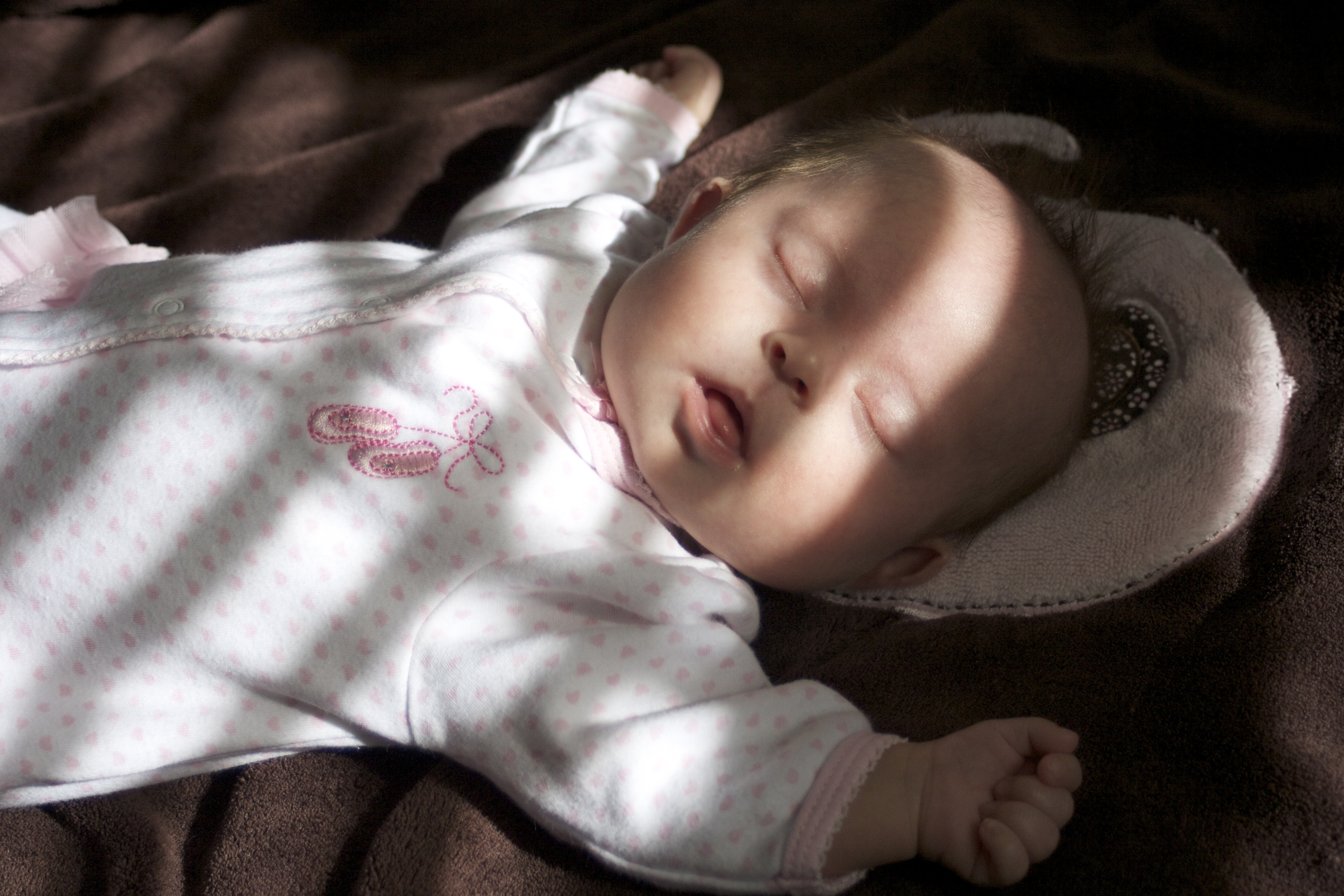
7 weeks


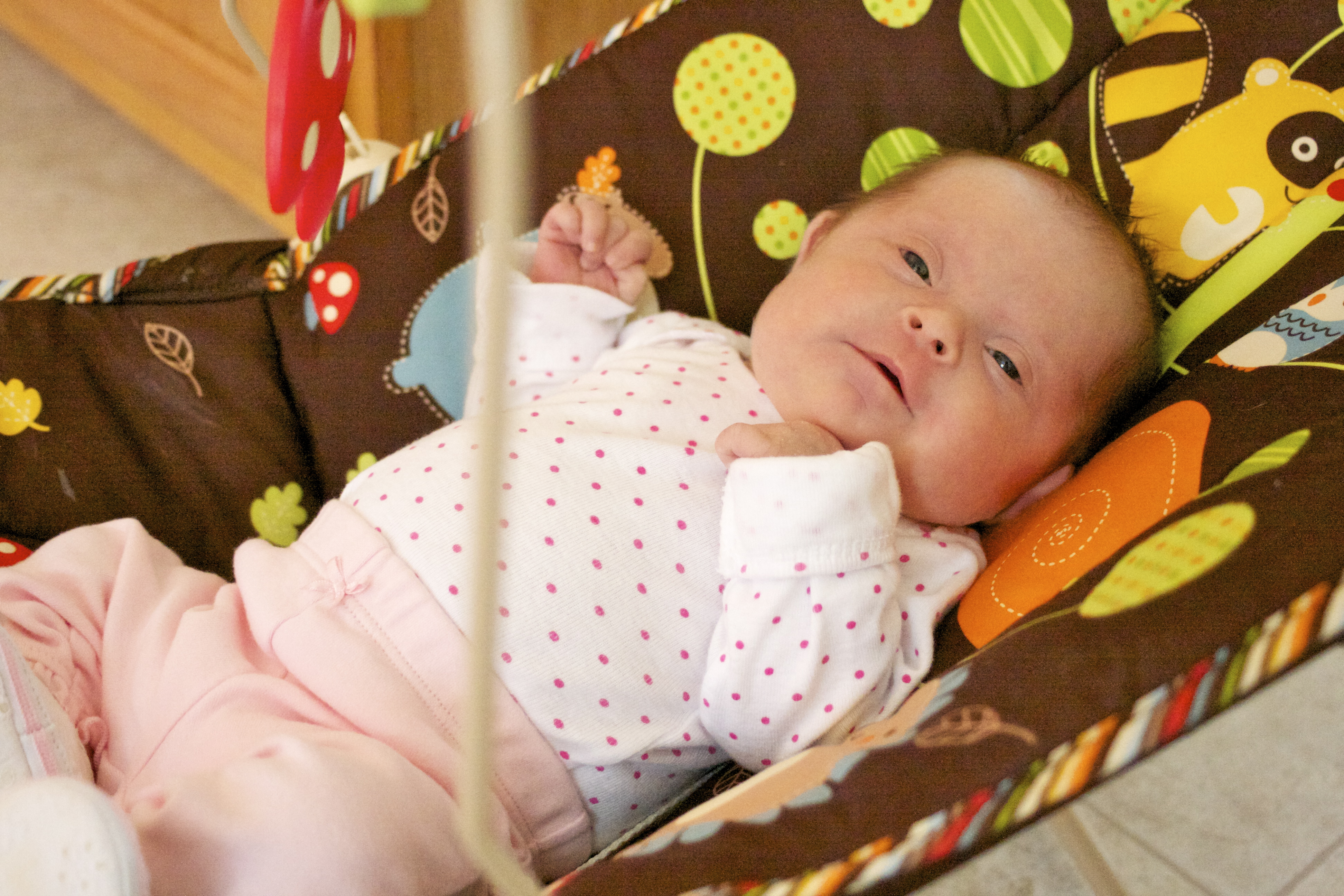
How could you not love this sweet face?

Eline at 6 weeks

  • Holding up her head – from tummy – for quite a few seconds at a time
  • Has rolled from stomach to back seven or eight times
  • Making eye contact more frequently, noticing objects, turning to look for the source of noises
  • On the verge of full smiles
  • Loves, loves, loves to be held and cuddled
  • Taking 3 1/2 to 4 oz. of pumped breast milk or part-breast milk/part-formula by bottle 7 times/day
  • Weighs a little over 8 lbs.

The road before us

I have followed the blog Enjoying the Small Things for probably the past couple years, and it has been consistently among my favorite internet reads. It’s written by Kelle Hampton, mother of two beautiful girls, the youngest of whom has Down syndrome. It has a huge readership, so many of you may already be familiar with it. In fact, a lot of people have recommended it to me in the last couple weeks. Kelle also recently published a book, which I just received as a gift and can’t wait to read. I’ve always strongly identified with her perspective on finding joy in the unexpected.

In the earliest moments of coming to terms with Lina’s diagnosis, I thought a great deal about that blog. It seemed so STRANGE that after so long reading about the Hampton family, I was now on such a similar journey. There have been moments when I have almost felt as if I somehow wished this upon myself. But aside from the uncanniness of the whole thing, it was so encouraging to be able to think about the beautiful photos of Kelle’s family. It helped me begin to picture our own family’s future. It seemed as if the time I had spent reading that blog had in some small way been preparation for Lina’s arrival.

In fact, there are a lot of things that, looking back, have probably helped prepare me for the experience of being Lina’s mommy. My dad was in an accident when I was 18 months old that left him legally blind. “Different is okay” was a theme of my upbringing, not just in what my parents said to us but in the whole way our family lived. I spent many, many hours at disability awareness seminars my parents helped conduct at churches all over the region. I had a childhood friend with a chromosome disorder similar to Down syndrome.

But it’s also been a bit jolting for me to realize how different it is now that it’s MY baby. I have smiled at children with Down syndrome in the stores or at the park and thought, “He is adorable,” or “She is just precious.” But suddenly I was thinking about the closet full of gorgeous clothes for my little girl and having a very hard time picturing those clothes on a child with Down syndrome. This is me being brutally honest. I was so accepting of everyone else’s children with Downs, but coming to terms with it being my child was a whole new ball game.

Those first couple days were complicated. I was initially in shock, just trying to wrap my head around this new reality. How I felt varied from minute to minute. Jon wanted to be sure we were able to celebrate the arrival of our sweet baby. I agreed, but I was surprised by what a relief it was when I called our embryo adoption counselor to tell her about the situation and her first response was, “Oh, Jolene, I am so sorry.” At that moment, I was hungry to have my feelings of grief and loss validated. I cried and cried on the counselor’s virtual shoulder.

Jon seemed to have an easier time coming to terms with Lina’s diagnosis than I did in those first few days. He was immediately on the internet, reading wikipedia entries and finding blogs by parents of children with Down syndrome. He found it encouraging to read stories of people with Downs leading successful lives. I wasn’t there yet. I did think and talk about the positives, but I was also grieving. During our NICU stay, I picked up a book about Down syndrome that had been given to us by our contact at Vandy’s Downs clinic. I started reading through the list of common health and developmental problems, and suddenly I felt very angry. It wasn’t so much for myself, but I was angry that my precious baby was going to have to face so many extra challenges. I resented that so many children would breeze through their milestones while my Lina had to work so much harder for every achievement. I felt envy for parents with “normal” babies. I thought about all the children in our circle of friends who will be so close to Lina’s age, and I grieved for the type of friendships I had imagined for my daughter. I thought about the family of the future I had imagined so many times: big, loud holiday gatherings with lots of grandchildren to fill our golden years. I thought, “Corin better marry someone who wants a lot of kids,” and then I thought, “Goodness, I hope I don’t actually put that kind of pressure on him.” Jon and I talked about how he had fallen in love with the name Eline because he pictured how elegant it would look on a wedding invitation. I felt keenly the loss of that future I had imagined for my daughter.

And yet, even as I grieved, God was working on my heart. Truthfully, I wasn’t doing a whole lot of praying. I just didn’t have the words, or the heart, to try to piece together what I needed to say to Him. Our first night in the NICU, I stood in the middle of the room after a midnight feeding, tears pouring down my face, and told God, “I don’t know what to say, but you know what’s in my heart. I need you more than ever before.” My faith was weak, and I was facing that question without an answer: “Why?” Why, after all the lengths we went to to give us the best odds of a healthy baby, after all the prayers we prayed, specifically asking God to bless our child with intelligence and to guide her development in the womb, why this outcome? Why, when it came to building our family, could nothing just be simple? I knew there was no answer, but asking the questions was a part of trying to process an outcome that was so very different from the expectations we held so closely for all those months.

Slowly, over those days in the NICU and in the following days since we’ve been home, my perspective has begun to shift. The second night in the NICU was much better than the first, and I found myself beginning to really bond with Lina. Over those late-night feedings, I looked into her face and began to recognize my daughter. The wheels of those deep instincts of motherhood began to turn, and I realized that already, I would go to the ends of the earth to give this child the best odds of happiness and success.

I began to see more clearly that my child’s extra chromosome will not prevent her from finding that happiness and success. Jon and I talked about how many “normal” people lead lives of dysfunction and unhappiness. It somehow brought me comfort to remember that having a child without development challenges does not guarantee freedom from parental disappointment or heartache. I began to remember the truths of those disability seminars: We all have our own difficulties. Some may be more visible than others, but they are there. Lina will have more challenges than some, but it was sinking in that she will find her own path to achievement and fulfillment. It is our job to help her. She will have her own interests and passions, her own talents and skills. They might not look like those we had imagined, but they will bring her happiness. I began to value the innocence she will likely carry with her through life.

As I have gotten to know this tiny new person over the past three weeks, I have fallen more and more in love. She is my precious daughter. I have stood over her cradle, watching her sleep, and breathed the prayer of every God-fearing parent: “You have entrusted her to me. Teach me. Help me be the mother she deserves.” I have looked down at her tiny form in the stroller as we walked at the greenway and felt joy that she is mine. I am more certain every day that her diagnosis does not change the fact that God chose this child for our family. I believed all along that He led us to embryo adoption, to our donor family, and to this baby. Yes, there is disappointment, confusion and pain, but I know Lina is a priceless gift, and I believe deep down in my soul that she will be a blessing in ways we can’t yet imagine.

Our day-to-day reality right now is really just your normal newborn stuff: round-the-clock feedings, sleep deprivation, lots and lots of tiny diapers, soaking burp cloths, the struggle to balance the needs of a toddler and a newborn while maintaining a semblance of normal routine. But truthfully, most of the time I’m finding it to be easier than I feared. I reserve the right to change my mind at any time, but for now, I am able to enjoy the tiny newborn stage with much less stress than I experienced with Corin. Lina’s feedings are complicated (nursing, pumping and supplementing by bottle), but she’s actually a better eater than Corin was at this age. Lina is a snuggler, and as much as I want her to sleep in her cradle peacefully all night, I kind of enjoy that she likes to be held close. I remember feeling in those first weeks with Corin as if someone had dropped me off on an alien planet; I recognized nothing of my life. This time, I have been pleasantly surprised by how much of our family life feels normal, even as so much has changed.

As we mark three weeks of Eline’s life, I am finding joy in picturing her as she grows. I think she’s going to be beautiful. And those clothes hanging in her closet? They are perfect for her. I know it won’t all be smooth sailing from here. There are still times when my heart hurts, and there will be many more of those as we walk the road in front of us. But this is our road, and as different as it is from where we thought we would be, it is beautiful in its own right. Here’s to the journey ahead.

Too Much Information

I’ve been thinking lately about the challenges of parenting in the Information Age. (You thought from the title you were getting a post on something juicy, didn’t you?!)

It seems to me we’re all on information overload. I realize this is a First World issue, a sign of privilege unknown in much of the world and even in many places here in the U.S. I am not ungrateful. I love the Internet; I clearly use it regularly. It’s my source for pretty much everything: recipes, tutorials, decorating ideas, world news, communication with long-distance friends, shopping, music… I did grow up in a time before the Internet and remember using library card files and researching school papers by digging through stacks of books, magazines and – gasp – even the occasional microfiche. Those are distant memories now, stories I will tell my children to reinforce their view that I grew up with Methuselah. Today, I often wonder, “How did people do this before the Internet?” I know that having a wealth of information at my fingertips, not to mention the entertainment options of Netflix streaming and online episodes of the Daily Show with Jon Stewart, is a gift that makes my life easier in so many ways.

As a parent, though, I am learning that living in a world of so much information has its down side. It begins before the baby arrives and never really lets up. There are endless decisions to make, and they all seem incredibly important. Some of them really are. Issues of pregnancy and child birth, information and support for breast feeding, questions of newborn schedules and sleep issues… Now with a toddler, it’s potty training methods, approaches to discipline, dietary advice and warnings, activities I should be doing with my kid but haven’t found the time for yet. As near as my computer screen is an endless supply of information and opinions on every possible parenting topic.

There is a tremendous amount of pressure on parents to be informed, to have a handle on the research and to parent according to the latest recommendations on Absolutely Everything. Given the sheer volume of decisions a parent makes in any given day, that would be no small task even if the information was always straight-forward and the experts always agreed. But it isn’t, and they don’t.

In a lot of ways, having access to so much information gives us a great deal of control. I am thankful for this, and I believe it is important to be an informed parent (and beyond that, an informed member of society). But the truth is, I’m not certain I know how to successfully navigate all of this.

Confession: I sometimes make parenting decisions without extensive research. Sometimes, I follow my gut. Sometimes, I trust Corin’s pediatrician without digging through the first 3,000 Google links. Have I picked the right issues to care about? Have I trusted the right sources? Have I reached the right conclusions? It’s pretty hard to know for sure.

My parenting philosophies don’t fall neatly into any category. I’ve gone with a “do what works” approach, which involves an awful lot of trial and error. One of the biggest surprises for me in parenting is how often the right answer is unclear. (He just threw his eating utensils on the floor. Again. On a scale of 1 to 10, how much does this matter? Not really sure.) I try to cut other parents a lot of slack and hope I’m doing an okay job wading through all of this myself.

Ultimately, I’m glad I believe in a Higher Power to guide my decisions, in parenting as in life. This job is certainly bigger than me.  I have a sense parents have always felt that way, in the Dark Ages or in the Information Age. Surely the fundamentals haven’t changed much. The rest… I suppose I’ll just keep praying and wading (or not) through the research.

Navigating the uncharted

I’d like to tell you about a couple of amazing people.

He’s a CPA. She’s a child/adolescent therapist. They live a few states away. She is a talented seamstress. He makes her laugh. Like us, they wanted a family but faced roadblocks. Their first IVF cycle resulted in their precious son and two cryopreserved blastocysts. A couple years later, they had a precious daughter. They knew they did not plan to pursue fertility treatments again, and so they had a decision to make.

They are our embryo donors. I don’t know exactly what went into their decision to donate. Jon and I had just a small taste of what they must have faced when we began our IVF process and considered the possibility of extra embryos. We know it wasn’t an easy choice, but our donors felt a sense of responsibility to those tiny blastocysts. And so they made an incredibly unselfish decision, and in so doing, gave us a gift of incalculable value. We have this opportunity to again become parents because of them, and I am still floored by that kind of generosity.

I mentioned in my earlier post that we felt a surprisingly strong connection with this family from the time we first began to learn a little more about them. In the early stages of our process and FET cycle, the counselor served as go-between and provided updates and photos to the families. Not long before our scheduled transfer, the counselor forwarded a note written directly to me by Lauren*. I was crying before I’d finished reading her words.

It was a simple note that said she was thinking of me every day. She said it was eerie how much we reminded her of her own family. She talked about what a good feeling she had about our transfer and how excited she was about the possibilities. If the note had been written on paper, I probably would have worn it out with rereading.

That same day, I sent the counselor a return note for Lauren*. We communicated by proxy several more times up to and after the transfer. Then, on the same day, without knowing the other had asked, we each suggested exchanging contact information. The counselor passed along our email addresses, and messages have flowed back and forth fairly regularly ever since.

I wasn’t sure when we first chose embryo donation what to expect in the way of a relationship with the donor family. Would it be weird or painful? Would we feel threatened or insecure about the donor family’s involvement? Would it somehow make our baby less ours? Jon and I both started out wanting our commitment to be fairly limited, although we were open to more if the conditions were right. Then we connected with OUR donor family, and it was no longer an abstract exercise. Now these were the generous, unselfish people who had given us our baby. We instinctively trusted them and trusted our collective ability to navigate this uncharted territory.

I don’t want to oversimplify. This is a relationship without an existing definition. We forge ahead without a map. It’s probably safe to say that for both the donors and for us, there are still joltingly emotional moments when we come face-to-face with the truly unique nature of what we’re doing. There will probably be more of those as this baby enters the world and becomes a part of our family. We don’t really know what this relationship looks like a year or five years from now. We play it very much by ear, and obviously, there are boundaries. Jon and I both already feel incredibly possessive and protective of this baby. If ANYONE dared to hint she is anything less than 100 percent ours, the parental lions would roar. But that has not happened. Both families understand this baby’s unquestioned place in our family, as our child. We also acknowledge the unique role her biological family has played, and we know they will continue to be a part of our lives as our daughter grows. I don’t know exactly what the future holds, but the sense of trust and openness has served us well through this process. I believe it will continue to be a great strength in the experiences ahead.

On Mother’s Day, Lauren* and I were thinking of each other, and we exchanged notes full of gratitude. It occurred to me that day that our baby is twice blessed, with two women who will have helped shape her life in very different ways. That thought might have made me uncomfortable a few months ago, but now, it makes me happy. The amazing thing about love in its best form is it multiples rather than divides.

In fact, with this baby, WE are twice blessed. We are richer for the incredible gift of our child and the presence in our lives of her remarkable genetic family.

*Name has been changed for privacy reasons.